
Can Blocked Gutters Damage Your Roof, Walls and Foundations? Warning Signs Every UK Homeowner Should Know
Gutters are one of the easiest parts of a home to forget about. They sit high up, out of sight, and as long as nothing is obviously dripping, most of us never give them a second thought. Yet in more than ten years of working on roofs across Hertfordshire, Bedfordshire, Buckinghamshire and North London, we have seen blocked gutters cause some of the most expensive and avoidable damage a house can suffer.
The short answer is yes. Blocked gutters can damage your roof, your walls and, over time, even your foundations. The good news is that the warning signs usually appear long before serious damage sets in, and a regular clean is one of the cheapest forms of protection you can buy for your home.
In this guide, we explain how gutters protect your property, what happens when they stop working, the warning signs to watch for, and how to keep water flowing where it should.
What Your Gutters Actually Do
Every time it rains, your roof collects a surprising amount of water. One millimetre of rain falling on one square metre of roof produces one litre of water. That means a typical 60 square metre roof sheds around 1,500 litres of water during a 25 millimetre downpour, which is not unusual for a wet day in the UK.
Your gutters and downpipes have one job: to catch all of that water and carry it safely away from the walls and foundations of your home, usually into a drain or soak-away. When they are clear, the system works quietly in the background. When they are blocked, all of that water has to go somewhere else, and it almost always ends up somewhere it can cause harm.
What Blocks Gutters in the First Place?
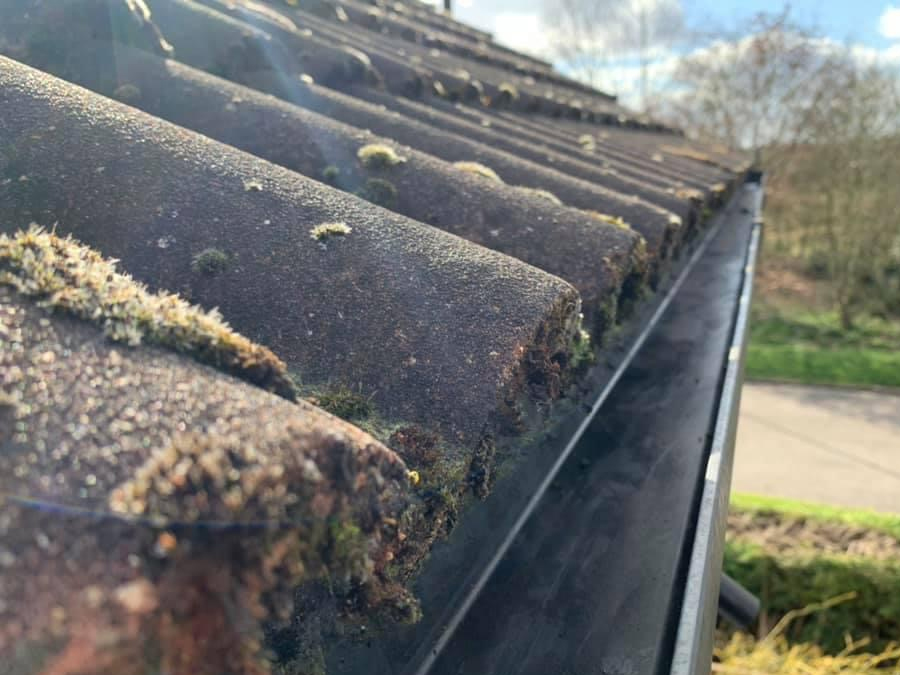
- Moss from the roof. This is the number one cause we find. Moss grows on roof tiles, dries out in warm weather and is washed or blown down into the gutters in clumps. Roofs with heavy moss growth can fill a gutter in a single season.
- Leaves and seeds. Homes near trees, hedges and woodland collect leaves every autumn and seeds and blossom every spring.
- Silt and tile grit. Older concrete tiles slowly shed fine grit, which settles in the bottom of the gutter and turns into a thick sludge.
- Plants and weeds. Once silt and moss build up, seeds take root and small plants grow inside the gutter itself, binding everything together.
- Bird nests and debris. Birds often nest in gutters and at the tops of downpipes, and tennis balls, toys and other items find their way up there more often than you might think.
How Blocked Gutters Damage Your Roof
Water backing up under the tiles
When a gutter is full, rainwater has nowhere to drain and can back up at the eaves. It may then soak into the bottom edge of the roof, where it can wet the underlay or felt and the timber behind it.
Rotten fascias and soffits
Fascia boards hold your gutters in place and soffits close off the underside of the eaves. When water constantly overflows, timber fascias and soffits stay wet, start to rot and can eventually fail. Rotten fascias may no longer hold the gutter securely, which leads to sagging, leaking joints and, in the worst cases, sections of gutter pulling away from the house.
Damage to rafter feet and roof timbers
The ends of your roof rafters sit just behind the fascia. Repeated soaking at the eaves can lead to rot in these timbers, which is far costlier to put right than a gutter clean.
Extra weight and strain
A gutter packed with wet moss, silt and standing water is extremely heavy. In winter that water can freeze, adding more weight and pressure. Over time this strains brackets and joints, causing gutters to sag, crack and leak.
How Blocked Gutters Damage Your Walls
Penetrating damp
When gutters overflow, water pours down the face of your walls. Brick and stone are porous, so a wall that is soaked again and again can let moisture through to the inside of the house. This is known as penetrating damp, and it often shows up as damp patches, bubbling paint or peeling wallpaper on upper floor walls and ceilings near the eaves.
Mould and poor air quality
Damp walls create the ideal conditions for black mould. This is unsightly, can damage decoration and furnishings, and is linked to breathing problems, particularly for children, older people and anyone with asthma.
Staining and efflorescence
Water running down brickwork leaves green algae streaks and dark tide marks. As the wall dries, salts within the brick and mortar are drawn to the surface and leave white, crusty deposits known as efflorescence.
Frost damage to brickwork
Saturated brickwork is vulnerable in winter. Water inside the brick freezes and expands, causing the surface of the brick to flake and crumble. This is known as spalling, and once it starts, the damaged brick often needs replacing.
Wet cavity wall insulation
Many homes have cavity wall insulation. If the outer wall is constantly saturated, moisture can reach the insulation, reducing how well it performs and helping damp travel through to the inner wall.
How Blocked Gutters Can Affect Your Foundations
This is the damage that takes longest to appear and can be the most serious. When water overflows from a blocked gutter or a disconnected downpipe, it lands in the same spot at the base of the wall every time it rains.
- Soil erosion. Concentrated water washes away soil around the base of the building, undermining paths, patios and the ground beside the foundations.
- Clay soil movement. Parts of our region, including areas of Hertfordshire and North London, sit on clay soils. Clay swells when it gets wet and shrinks when it dries out. Repeated soaking and drying beside a wall can contribute to ground movement over time.
- Damp in cellars and basements. Water collecting at the base of the house can find its way into cellars, basements and under floors.
- Sunken paths and patios. Soil washed away from under paving leads to dips, cracks and uneven surfaces.
If you notice new cracks in your walls, especially cracks that are wider at the top than the bottom, or doors and windows that suddenly start sticking, it is worth asking a structural surveyor to take a look. Blocked gutters are rarely the only cause of structural movement, but keeping water away from your foundations is always a sensible first step.
Warning Signs of Blocked Gutters
Here are the signs we tell every homeowner to look out for. Most can be spotted from the ground with nothing more than a quick walk around the house during or just after rain.
| Warning sign | What it usually means | How urgent? |
|---|---|---|
| Water spilling over the gutter edge in rain | Gutter or downpipe is blocked | Act soon |
| Plants or grass growing out of the gutter | Thick build up of silt and moss | Act soon |
| Gutter sagging or pulling away from the fascia | Heavy load, failing brackets or rotting fascia | Act quickly |
| Dark streaks or tide marks on brickwork | Repeated overflow down the wall | Act soon |
| Green algae on walls below the gutter | Wall staying wet for long periods | Act soon |
| Peeling paint or rot on fascias and soffits | Timber being soaked regularly | Act quickly |
| Damp patches on upper floor ceilings or walls | Penetrating damp from overflow | Act quickly |
| Puddles or erosion at the base of walls | Water landing beside the foundations | Act quickly |
| Dripping from gutter joints | Blockage putting pressure on joints | Monitor and clean |
| Birds or insects nesting in the gutter | Gutter offering shelter due to debris | Clean and check |
How Often Should Gutters Be Cleaned?
For most UK homes, we recommend having your gutters cleaned at least once a year. If your home is surrounded by trees, or your roof has a lot of moss, twice a year is better, ideally once in late autumn after the leaves have fallen and again in spring.
You should also have your gutters checked after any roof cleaning or moss removal. Even with careful work, some moss and debris finds its way into the gutters, so clearing them should always be part of the job. That is why gutter vacuuming is included in every one of our roof cleaning packages, from Bronze through to Gold.
Why DIY Gutter Cleaning Can Be Risky
Many homeowners climb a ladder with a trowel and a bucket, and for a bungalow with easy access that can be manageable. For most two-storey homes, though, it is a different story. Working at height from a ladder is one of the most common causes of serious accidents at home. Leaning ladders against plastic guttering can also crack it, and simply scooping out the top layer of debris often leaves the downpipes blocked.
Professional gutter cleaning is safer and more thorough. Our team uses specialist gutter vacuum equipment to remove moss, leaves and silt from the full length of the gutter, and we check the downpipes are flowing freely before we leave. We are fully insured and trained to work at height, and we can provide before and after photos so you can see the results for yourself.
How We Clean Gutters at A&R
- Inspection. We check the condition of your gutters, downpipes, fascias and soffits and look for any signs of damage or overflow.
- Gutter vacuuming. Powerful vacuum equipment removes moss, leaves, silt and debris from every run of guttering.
- Downpipe check. We make sure water flows freely through the downpipes and into the drains.
- Tidy up. All waste is bagged and removed from your property, and paths and patios are left clean.
- Report and photos. We let you know about anything we spotted, such as loose brackets, leaking joints or slipped tiles, so you can deal with it early.
You can find out more on our gutter cleaning service page. If moss on your roof is the main source of the blockage, our roof moss removal service tackles the problem at the source, and you can compare our options on our packages page.
Frequently Asked Questions
Can a blocked gutter cause a roof leak?
Yes. When a gutter is full, water can back up at the eaves and soak the bottom edge of the roof, the underlay and the timber fascia. Over time this can lead to leaks, rot and damp inside the loft or upper rooms.
How do I know if my downpipe is blocked?
Watch your downpipe during heavy rain. If water spills over the gutter close to the downpipe, gurgles loudly, or very little water comes out at the bottom, the downpipe is probably blocked.
Can blocked gutters cause damp inside my house?
They can. Overflowing water soaks the outside walls, and in time the moisture can pass through the brickwork to the inside of the house, causing damp patches, mould and damaged decoration.
What time of year is best for gutter cleaning?
Late autumn, once the leaves have fallen, is the most important time. A second clean in spring is a good idea for homes near trees or with mossy roofs.
Do you clean gutters after roof cleaning?
Yes. Gutter vacuuming is included in all of our roof cleaning packages, and our Silver and Gold roof packages also include a full gutter clean.
Which areas do you cover?
We cover Hertfordshire, Bedfordshire, Buckinghamshire and North London, including Luton, Dunstable, St Albans, Harpenden, Watford, Hemel Hempstead, Milton Keynes, Leighton Buzzard, Stevenage, Aylesbury, Enfield and the surrounding towns and villages.
Protect Your Home Before Winter Sets In
Blocked gutters rarely look like an emergency, but the damage they cause builds quietly year after year. A professional gutter clean costs a fraction of what it takes to repair rotten fascias, damp walls or damaged brickwork.
Alan, Russell and the team are fully insured, trained to work at height and trusted by homeowners across the Home Counties, with more than 400 reviews on Google, Checkatrade, Which? Trusted Traders and Facebook. Call us on 01582 757304 or request a free quote today.
Call Now