
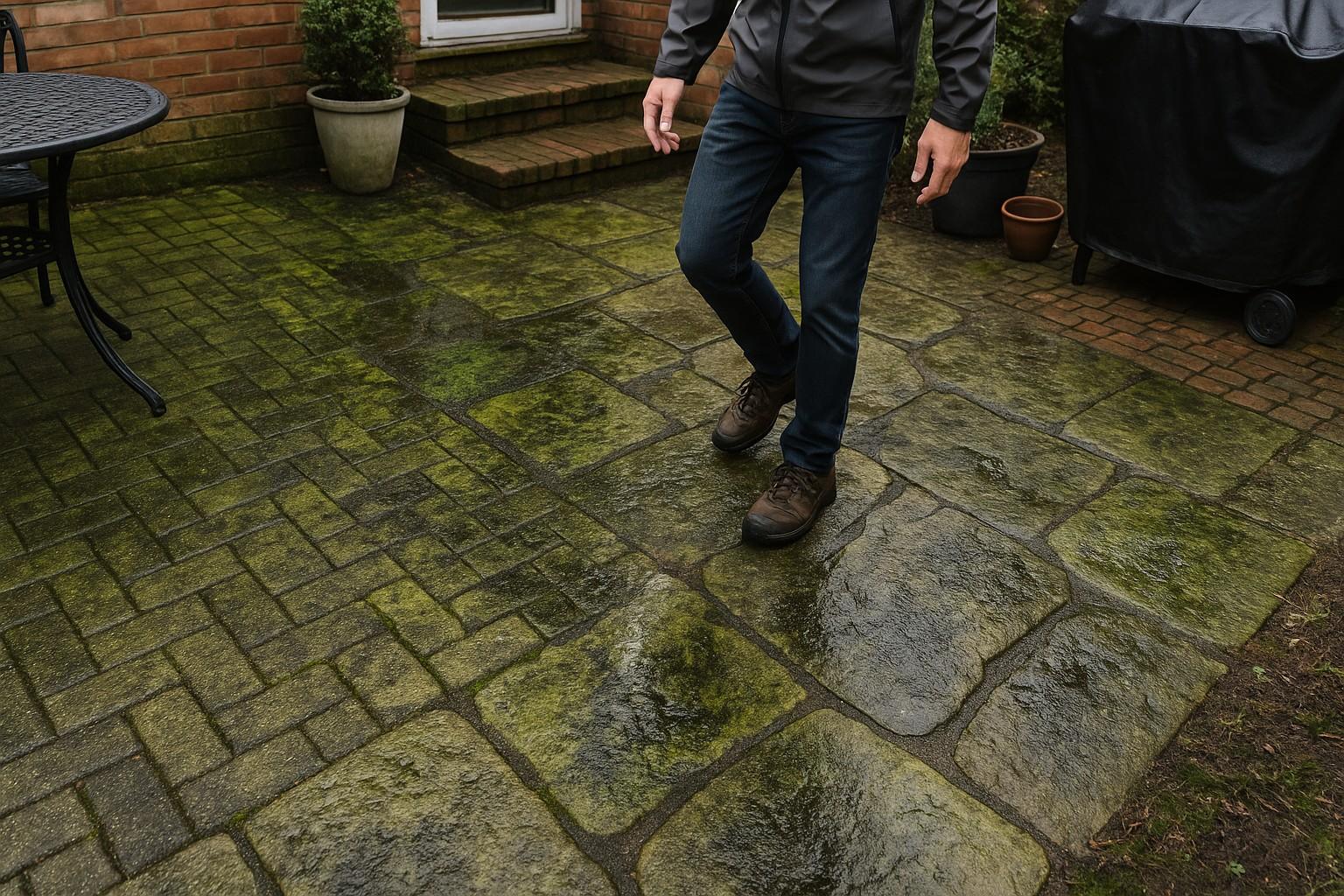
Why Does Your Patio Become Slippery After Rain and How Can You Fix It?
Every autumn our phones get busier with the same kind of call. A homeowner in Luton, St Albans or Hemel Hempstead tells us their patio looked perfectly fine all summer, then after the first proper week of rain it turned into something closer to an ice rink. Some have already had a fall. Others are worried about an elderly parent, young children or a dog charging out of the back door.
A slippery patio is rarely just bad luck. In almost every case it is a sign that something is growing on the surface, that water is not draining away properly, or that the slabs themselves have been finished or treated in the wrong way. The good news is that each of these causes can be identified and fixed, and most patios can be made safe again without lifting a single slab.
In this guide, we explain why rain makes patios so slippery, how to work out which problem you have, the common mistakes that make things worse, and how we restore grip on patios across Hertfordshire, Bedfordshire, Buckinghamshire and North London.
Why Rain Turns a Patio Slippery
Clean stone or concrete with a little water on it actually offers reasonable grip. The danger comes from what the water reacts with. Rain softens and swells organic growth that sits on the surface, turning a thin, almost invisible layer into a slick film underfoot. Here are the most common culprits we find.
Green algae and biofilm
Algae is the number one cause of slippery patios in the UK. It starts as a microscopic film of algae and bacteria known as biofilm. When the weather is dry you may barely notice it, perhaps just a slight dullness or green tinge. Once it rains, the film absorbs water and becomes a slimy gel that behaves almost like soap on the stone. Algae loves the damp, mild conditions we get through autumn, winter and spring, which is exactly why patios seem to change overnight when the weather turns.
Moss in the joints and along the edges
Moss tends to settle in the joints between slabs, along walls and fences, and in corners where water collects. On its own it is less slippery than algae, but it holds moisture like a sponge. That keeps the surrounding stone wet for longer, which in turn feeds more algae. Moss in the joints also pushes jointing material out over time, leaving gaps that collect more dirt and seeds.
Lichen and black spots
Those stubborn black dots you see on sandstone and concrete slabs are usually lichen. Lichen bonds tightly to the stone and will not shift with a brush or even a standard pressure wash. The spots themselves are not always the slippiest part of the patio, but they are a clear sign that the surface has been colonised by organic growth and that algae will not be far behind. We cover this in more detail in our guide to patio black spot removal causes and prevention.
Rotting leaves and garden debris
Leaves, blossom, grass cuttings and soil washed out of flower beds break down on the patio surface. As they rot they release tannins and nutrients, leaving dark stains and a slimy layer that is lethal after rain. Patios near trees, hedges and borders are always the worst affected.
Smooth, polished or glossy surfaces
Some surfaces are naturally smoother than others. Porcelain paving, polished limestone and some smooth concrete slabs give less grip than textured riven sandstone, especially once a thin layer of algae forms. A patio sealed with the wrong product can also be a problem. Some cheap sealers sit on top of the stone as a glossy film, and that film becomes slippery when wet.
Standing water and poor drainage
A patio should be laid with a gentle fall so rainwater runs away from the house, usually somewhere around 1 in 60 to 1 in 80. Over the years slabs can sink, joints can wash out and drains can block. When water sits in puddles it keeps the surface wet for hours or days, giving algae everything it needs to thrive.
Shade and north facing gardens
Patios that get little direct sun stay damp far longer than those in full sun. North facing gardens, patios under trees, and areas tucked between buildings are almost always the first to turn green. The same principle applies to roofs, as we explain in our article on why north facing and shaded roofs get more moss.
How to Tell What Is Making Your Patio Slippery
Before you spend money on products or a professional clean, a few simple checks will tell you a lot about what you are dealing with.
- Feel it when wet. Carefully run your fingers across a damp slab. If it feels slimy or greasy, algae and biofilm are the main problem.
- Look for colour. A green tint that darkens after rain points to algae. Black or grey dots that will not scrub off are lichen.
- Check the joints. Empty joints, crumbling mortar or moss growing between slabs mean water is sitting in the gaps and growth is spreading from there.
- Watch it after a shower. If puddles are still sitting on the patio half an hour after the rain stops, drainage is part of the problem.
- Notice any shine. A glossy, plastic look on the surface, especially on a patio that was sealed in the past, suggests a film forming sealer that may now be reducing grip.
- Think about the location. Shade, overhanging trees and nearby borders all increase the risk and mean the patio will need more regular care.
Most slippery patios we visit have two or three of these issues at the same time, which is why a single quick fix rarely lasts.
Different Patio Surfaces and How They Behave in the Rain
| Patio Surface | Why It Gets Slippery | What Usually Fixes It |
|---|---|---|
| Indian sandstone | Porous stone holds moisture, algae and lichen take hold quickly | Deep clean, biocide, black spot treatment, breathable sealer |
| Concrete slabs | Surface wears smooth, algae film and dirt build up | Pressure clean, biocide, sealing to slow regrowth |
| Porcelain | Very smooth surface, thin algae film is enough to cause slips | Careful clean and biocide, regular maintenance, no glossy coatings |
| Limestone | Smooth face, sensitive to acidic cleaners | Gentle clean with stone safe products, biocide, suitable sealer |
| Slate | Naturally smooth, holds a damp film in shade | Low pressure clean, biocide, regular rinsing |
| Block paving patios | Joints lose sand and fill with moss and weeds | Clean, biocide, resanding, joint stabilising sealer |
Common Mistakes That Make a Slippery Patio Worse
When a patio becomes dangerous, it is natural to want to grab whatever is under the kitchen sink and get scrubbing. Unfortunately, a few common approaches can make the surface more slippery or even damage the stone.
- Washing up liquid and detergents. These leave a soapy residue behind that can make wet slabs even slicker than before.
- Neat household bleach. Poured straight on, bleach can mark some natural stones unevenly, harm lawn edges and plants, and is unpleasant around pets. It also does little to stop growth coming back.
- Holding a pressure washer too close. A domestic pressure washer used at close range can etch sandstone, blast out jointing and drive spores deeper into the surface. The patio looks clean for a few weeks, then turns green again faster than before.
- Sprinkling sand or salt. These give a little temporary grip, but they wash away with the next downpour and do nothing about the cause.
- Using a glossy sealer from a DIY shop. A shiny finish can look great on day one, yet it may cut grip when wet and trap moisture if the stone was not completely dry.
How We Fix a Slippery Patio Properly
At A&R Roof & Hard Surface Cleaning & Restoration, our aim is not just to make your patio look clean for a few weeks. We want it to stay safe through the wet months and to keep regrowth to a minimum. This is the process we follow on most patio jobs.
- Survey and stone identification. We look at the type of stone or slab, the level of algae, moss and lichen, the condition of the joints and how water drains across the patio. This tells us which methods and products are safe for your surface.
- Protecting the surroundings. Doors, windows, render, plants and garden furniture are protected or moved before any work begins.
- Deep clean with controlled pressure. We use professional rotary surface cleaners that clean evenly without the stripes and etching caused by a lance held close to the stone. Pressure is adjusted to suit the surface, so a delicate limestone is treated very differently from a tough concrete slab.
- Biocide treatment. This is the step most DIY cleans miss. A professional biocide kills the algae, moss and lichen spores left in the pores of the stone, which slows regrowth and keeps the patio safer for longer.
- Black spot and lichen treatment. Where lichen is present we apply a dedicated treatment through our patio black spot removal service so the stubborn spots fade away rather than lingering.
- Repointing failed joints. Empty or crumbling joints hold water and moss. Our patio repointing service fills them with a durable jointing compound, closing the gaps where growth and water collect.
- Sealing with the right finish. Once the patio is fully dry, we can apply a breathable sealer through our patio sealing service. Sealing slows the absorption of water and dirt, so algae finds it much harder to take hold. Where grip is a concern we recommend a natural or matt finish rather than a high gloss look.
Our patio packages bring these steps together. Bronze covers cleaning and biocide treatment, Silver adds sealing, and Gold adds repointing on top. You can compare them on our packages page or learn more about our patio cleaning service.
Simple Ways to Keep Your Patio Safe Through the Year
A professional clean and seal gives you a fresh start. A little regular care keeps it that way.
- Sweep regularly in autumn. Leaves left to rot are one of the fastest routes back to a slimy surface. A quick weekly sweep makes a real difference.
- Trim back plants and trees. Cutting back overhanging branches and shrubs lets in more sunlight and air, helping the patio dry out after rain.
- Keep drains and gullies clear. Make sure water has somewhere to go, and look out for any slabs that start to sink and hold puddles.
- Rinse after winter. A gentle rinse with a hose in spring removes surface dirt before it becomes a home for algae.
- Book a maintenance treatment. For shaded or heavily used patios, a light clean and biocide treatment every year or so keeps things under control.
- Reseal when needed. Sealers wear over time, especially in high traffic areas. Resealing every few years keeps the protection working.
When to Call in a Professional
It is time to get expert help if your patio is slippery even after you have cleaned it, if black spots and lichen will not shift, if the joints are empty or failing, or if you have natural stone that you are worried about damaging. It is also worth calling us if anyone in your home is elderly, unsteady on their feet or has young children who play outside. Making the patio safe is often far quicker and more affordable than people expect.
Make Your Patio Safe Again
A slippery patio is more than an eyesore. It is a safety risk that tends to get worse every wet season. The A&R team have spent more than a decade restoring patios and we can usually bring back grip, colour and kerb appeal without the cost and disruption of replacing your slabs.
Call us today on 01582 757304 or request a free quote online, and we will recommend the right treatment for your patio.
Call Now