
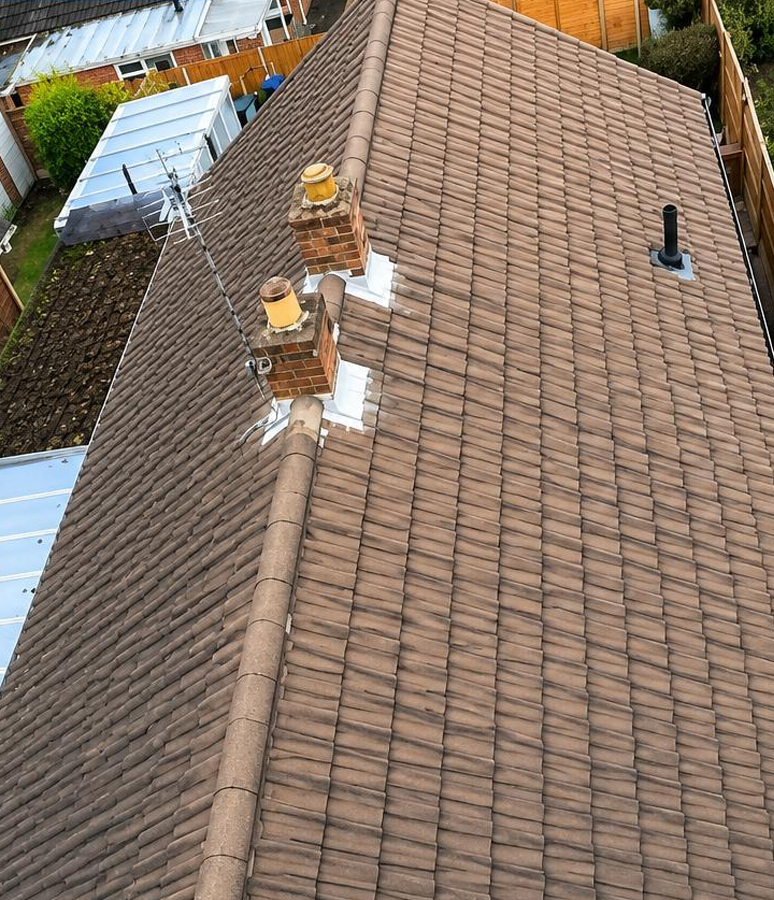
Get Rid of Moss on Roof Tiles Without Damaging Your Roof
Moss on a roof is easy to spot and surprisingly easy to make worse. Every year we visit homes across Hertfordshire, Bedfordshire, Buckinghamshire and North London where the moss has gone, but so has part of the roof: cracked tiles from someone walking on them, ridge mortar blasted out by a pressure washer, or water stains in the loft after a clean that forced rain under the tiles.
Getting rid of moss is not difficult. Getting rid of it without damaging the roof is where skill, the right equipment and the right method make all the difference. In this blog, we explain how moss attaches to your tiles, which removal methods are safe, which ones to avoid, and how to stop the moss coming straight back.
The Quick Answer
The safest way to get rid of moss on roof tiles is to remove the bulk of it by hand using non-metal tools, then treat the tiles with a professional biocide or a low-pressure soft wash, and rinse gently with low-pressure or heated water where suitable. High-pressure washing, harsh scraping with metal tools and climbing onto the roof without the right equipment are the most common causes of damage.
How Moss Attaches to Roof Tiles
Moss does not have true roots. Instead it grows thin, hair-like strands that grip the rough surface of the tile and work their way into the small gaps between overlapping tiles. Once established, it forms thick cushions that soak up water like a sponge.
That is why moss is so damaging and also why it has to be removed carefully. Pull too hard or blast it with high pressure and you can take the surface of the tile with it, or force water under the tiles where it should never go.
What Makes Roof Moss Removal Risky?
Every roof is different, but most damage during moss removal comes from one of four things:
- Weight on the tiles. Concrete and clay tiles are designed to keep rain out, not to carry the weight of a person. Walking on them, especially when they are wet and mossy, can crack them.
- Too much pressure. High-pressure water can strip the protective surface from concrete tiles, erode older clay tiles and blow out ridge, hip and verge mortar.
- The wrong tools. Metal scrapers, wire brushes and garden hoes can chip tile edges and scratch the surface, making it easier for moss to grow back.
- Water in the wrong place. Spraying water upwards under the tile overlaps can push it past the tiles and onto the underlay, battens and loft insulation.
Safe Moss Removal Methods Compared
|
Method |
How it works |
Risk to tiles |
Long term result |
|
Manual moss removal |
Moss is lifted off by hand with plastic or wooden scrapers |
Low when done from proper access |
Removes the bulk of moss but leaves spores behind on its own |
|
Soft washing |
A professional cleaning solution and biocide applied at very low pressure |
Very low |
Kills spores and slows regrowth |
|
Heated low pressure cleaning |
Hot water at a controlled temperature softens and lifts growth |
Low |
Brightens tiles and removes residue, best combined with a biocide |
|
Biocide treatment only |
A biocide is sprayed on and left to work over weeks |
Very low |
Gradual results, often with dead moss left to wash off |
|
High-pressure washing |
A powerful jet blasts the moss away |
High |
Quick visual result, but can damage tiles and speed up regrowth |
The best results usually come from combining methods rather than relying on one. Our article on manual scraping vs chemical only treatment explains why.
How We Remove Moss Without Damaging Your Roof
Step 1: A careful roof assessment
Before any work begins, we look at the tile type, its age and condition, the amount of moss, the pitch of the roof and the access. We also look for anything that needs extra care, such as solar panels, roof windows, aerials or fragile tiles.
Step 2: Safe access
We avoid putting weight directly on your tiles. Depending on the roof, we use roof ladders, crawling boards or powered access equipment, and our team holds IPAF training for working safely at height.
Step 3: Manual moss removal
The thick cushions of moss are lifted away by hand using tools that will not scratch or chip the tiles. We work down the roof in the direction the tiles overlap, so we never lever tiles up or push debris underneath them.
Step 4: Soft washing or heated cleaning
Depending on your package and the roof, the tiles are then cleaned using roof softwashing at very low pressure, or heated roof cleaning at 60°C with low pressure. Both remove remaining growth without the risks of high pressure washing.
Step 5: Biocide treatment
A professional biocide is applied to kill the spores left in the pores of the tiles. This is the step that keeps your roof cleaner for longer.
Step 6: Gutter clearance and tidy up
Moss always falls into the gutters during cleaning, so gutters are vacuumed and cleared, and all debris is removed from your paths, patios, lawns and driveway.
Step 7: Photos and a roof report
We provide before and after photos and let you know about anything we found, such as cracked or slipped tiles that were hidden under the moss.
Mistakes That Damage Roofs During Moss Removal
- Pressure washing the roof. It is the fastest way to remove moss and one of the most common causes of tile damage, leaks and faster regrowth.
- Walking on wet, mossy tiles. It risks broken tiles and, far more seriously, a fall from height.
- Using metal tools. Scrapers, wire brushes and hoes can chip tiles and remove their protective surface.
- Pouring bleach or household products onto the roof. These can harm plants, pets and gutters and do little to stop moss returning.
- Ignoring the gutters. Loose moss washed into gutters can block them within weeks.
- Coating or painting over moss. Any sealer or paint applied over growth or damp tiles will fail.
Can You Remove Roof Moss Yourself?
For a single-storey extension or garage roof that can be reached safely from the ground or a properly secured platform, a homeowner can remove small amounts of moss by hand with a plastic scraper. Even then, we recommend never standing on the roof itself.
For most two storey homes, roof moss removal is a job for trained professionals. Falls from height are one of the leading causes of serious accidents in the UK, and damaged tiles can turn a moss problem into a leak. Professional teams have the access equipment, insurance and experience to do the job safely.
Does Tile Type Change the Method?
|
Tile type |
What to watch for |
Our approach |
|
Concrete tiles |
Worn surface on older roofs, easily eroded by pressure |
Hand removal, heated or soft wash cleaning, biocide, optional sealing |
|
Clay tiles |
Can become brittle and flake with age |
Gentle hand removal and low pressure cleaning |
|
Natural slate |
Brittle when walked on |
Careful access, hand removal and soft washing |
|
Artificial slate |
Older types may contain asbestos |
Assessment first, gentle methods only |
How to Stop Moss Coming Back
- Have a biocide applied. It kills remaining spores and slows regrowth considerably.
- Consider roof sealing. A breathable roof sealing treatment reduces how much water porous tiles absorb, making it harder for moss to settle.
- Keep gutters clear. Clean gutters at least once a year so water drains away freely.
- Trim back overhanging trees. More sunlight and air help your roof dry faster after rain.
- Keep an eye on shaded slopes. North facing roofs regrow fastest, as we explain in our article on why north facing and shaded roofs get more moss.
What Our Roof Packages Include
- Bronze: Non pressure roof cleaning with manual moss removal, softwashing and gutter vacuuming, plus a 3 year no moss regrowth guarantee
- Silver: Heated roof cleaning at 60°C, biocide treatment, gutter vacuuming and gutter cleaning, plus a 3 year no moss regrowth guarantee
- Gold: Everything in Silver plus roof tile sealing, with a 5 year no moss regrowth guarantee
You can compare them on our packages page or read more about our roof moss removal service.
Frequently Asked Questions
What is the safest way to remove moss from a roof?
Hand removal with non-metal tools, followed by a low-pressure soft wash or heated clean and a biocide treatment, carried out from proper access equipment. This removes the moss without stressing the tiles or forcing water under them.
Does pressure washing damage roof tiles?
It can. High pressure can strip the surface of concrete tiles, erode clay tiles, blow out mortar and drive water into the roof space. It also leaves tiles rougher, which helps moss return faster.
Will moss die if I just spray it?
A biocide will kill moss over time, but dead moss can take months to wash off and may still block gutters as it falls. Combining hand removal with a biocide gives a faster, cleaner result.
How long does roof moss removal take?
Most homes are completed in a few hours to a day, depending on the size of the roof, the amount of moss and the access.
Can moss be removed from a roof with solar panels?
Yes, but the panels must be worked around carefully. Tell us about any panels when you request a quote so we can plan the job.
What time of year is best for removing roof moss?
Moss can be removed throughout the year. Work may be postponed for a day or two during heavy rain, frost or snow.
Remove Roof Moss the Safe Way
Moss can be removed quickly, but only the right method removes it without harming your roof. Gentle hand removal, low pressure cleaning and a professional biocide protect your tiles while keeping moss away for years.
Alan, Russell and the A&R team are Smartseal trained and accredited, fully insured and trusted by homeowners across Luton, Dunstable, St Albans, Harpenden, Watford, Hemel Hempstead, Milton Keynes, Aylesbury and the surrounding areas, with more than 400 reviews online. Call 01582 757304 or request a free quote today.
Call Now