
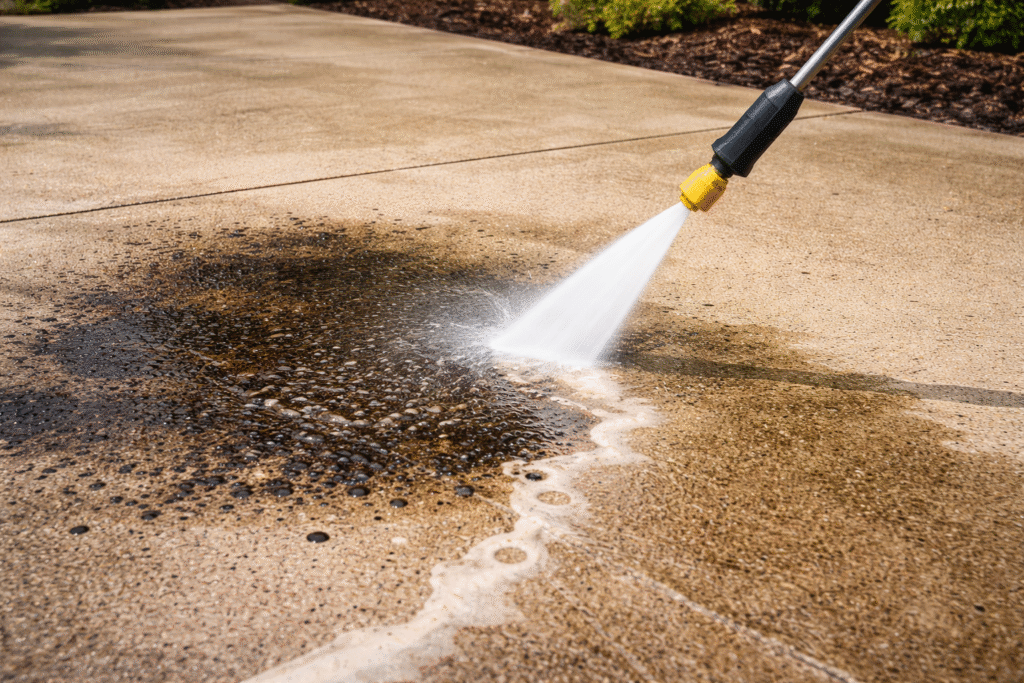
How to Remove Oil and Tyre Stains From a Driveway?
Oil drips and tyre marks are two of the most common complaints we hear from UK homeowners, and they’re often mistaken for the same problem. They’re not. Oil soaks into the surface and needs to be lifted out, while tyre marks are usually rubber transferred onto the surface and need to be broken down differently. Using the wrong method on either can leave a permanent shadow on your driveway, especially on block paving and resin surfaces.
This guide walks through how to treat both types of stain safely, when DIY is worth attempting, and when it’s time to call in a professional driveway cleaning service instead.
Why Oil and Tyre Stains Are Hard to Remove
Block paving, tarmac, and concrete are all porous to some degree, which means oil doesn’t just sit on top of the surface, it works its way in. Tarmac in particular is more delicate than block paving or concrete, since its bitumen binder can be damaged by the wrong cleaning approach – our guide on cleaning tarmac driveways without causing damage covers this in more detail. The longer a stain is left, the deeper it penetrates and the harder it becomes to shift. UK weather doesn’t help either; rain can spread a fresh oil patch further into the surrounding surface before it’s had a chance to be treated. Tyre marks are a different problem entirely; they’re caused by rubber compound transferring onto the surface under friction and heat, most often when a car turns on the spot or brakes sharply.
What You’ll Need Before You Start
- Absorbent granules, cat litter, or sawdust (for fresh oil only)
- A driveway-safe degreaser (avoid strong solvents on resin or coloured block paving)
- A stiff outdoor brush, not a wire brush
- A hose or pressure washer set to a moderate setting
- Protective gloves and eyewear
Removing Fresh Oil Stains: Step-by-Step
Fresh oil is the easiest stain to deal with yourself, provided you act quickly.
- Cover the stain with absorbent granules or cat litter and leave for several hours to draw out as much oil as possible before it sets.
- Sweep away the absorbent material and apply a driveway-safe degreaser directly to the mark, following the product’s dwell time.
- Scrub with a stiff brush in a circular motion, working the degreaser into the surface rather than just across it.
- Rinse thoroughly with a hose or moderate-pressure setting, checking the stain has lifted before it dries again.
Removing Old or Set-In Oil Stains
Deeply set-in oil stains are a different challenge. By this stage, the oil has usually penetrated below the surface, particularly into the jointing sand on block paving, and household degreasers will only lighten the mark rather than remove it fully.
When DIY Reaches Its Limit
If a stain has been there for months or years, repeated scrubbing with household products can do more harm than good, especially on resin or coloured block paving, where aggressive scrubbing can dull the finish. This is usually the point where a professional driveway cleaning service is worth the cost, as commercial-grade treatments and van-mounted equipment can lift far more of the stain without damaging the surface underneath.
Removing Tyre Marks
- Tyre marks respond differently to oil because you’re dealing with transferred rubber rather than an absorbed liquid. A degreaser alone often isn’t enough.
- Apply a small amount of white spirit or a specialist rubber-mark remover to a cloth, not directly onto block paving joints.
- Work the mark gently with a stiff brush, testing an inconspicuous area first on resin or coloured surfaces.
- For scuffs across a wide area, such as a turning circle, a professional soft washing or pressure washing pass is usually more effective and more consistent than spot-treating by hand.
DIY vs. Professional Driveway Cleaning
For a single fresh stain, DIY is often enough. For older stains, wide tyre scuffing, or driveways that haven’t been treated in years, professional equipment tends to get better and more even results. The table below summarises when each approach makes sense.
| Factor | DIY Cleaning | Professional Driveway Cleaning |
| Fresh, surface-level oil marks | Often effective with degreaser and a stiff brush | Also effective, with less risk of pushing residue into joints |
| Old, deeply set-in stains | Usually only lightens the mark | Van-mounted equipment and commercial-grade treatments lift far more of the stain |
| Block paving joints | Hard to treat without disturbing jointing sand | Joints cleaned and re-sanded as part of the job |
| Risk of surface damage | Higher, if wrong chemical or pressure is used | Lower, method matched to surface type |
| Time investment | Can take a full weekend for a large driveway | Typically half a day to a full day |
How to Stop Oil and Tyre Stains Coming Back
Cleaning removes what’s already there, but it doesn’t stop the next oil drip from soaking straight back into an unprotected surface. This is where driveway sealing services comes in. A sealed driveway forms a protective barrier that stops oil, fuel, and general grime from penetrating the surface in the first place, so future spills sit on top long enough to be wiped away rather than absorbed.
If you have block paving specifically, see our breakdown of the benefits of sealing block paving for how sealant also protects against colour loss and jointing sand erosion, not just staining.
Sealing is particularly worth considering if your driveway has a regular parking spot for the same vehicle, is used by more than one car, or has previously had a stain that took real effort to remove. Most homeowners we work with have their driveway cleaned first, then sealed straight after, since sealant adheres better to a surface that’s already free of built-up dirt and old staining.
Choosing a Professional Driveway Cleaning Company
If a stain isn’t shifting, or you’d rather not spend a weekend on your hands and knees with a degreaser, look for a contractor who can show:
- Checkatrade, TrustATrader, or Which Trusted Trader accreditation
- Experience with your specific surface type, block paving, tarmac, resin, or concrete
- A clear explanation of pressure levels and chemicals used on different surfaces
- A free, no-obligation quote before any work begins
- The option to combine cleaning with driveway sealing for longer-lasting protection
A driveway that’s been professionally cleaned and then sealed tends to resist future oil and tyre marks far better than one that’s only ever pressure washed. If you’re dealing with a stubborn stain right now, our driveway cleaning page has more detail on the methods we use across block paving, tarmac, concrete, and resin driveways.
Stubborn Oil or Tyre Stains That Won’t Budge?
A&R Roof & Hard Surface Cleaning & Restoration offers free, no-obligation quotes for driveway cleaning and sealing across Harpenden, St Albans, Watford, Milton Keynes, Dunstable and the surrounding areas.