
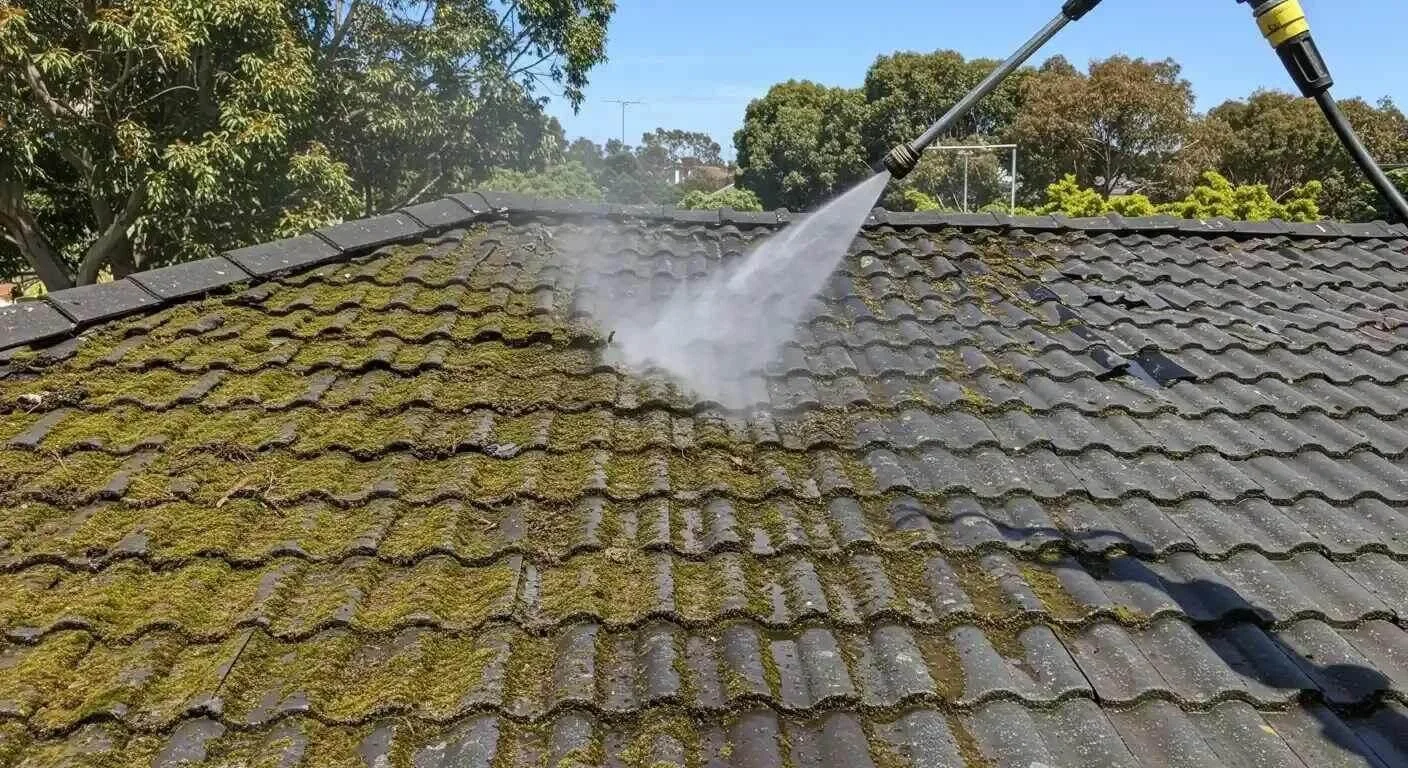
Eco-Friendly Roof Cleaning: Are the Chemicals Used Safe for Gardens, Pets and Wildlife?
A customer in Berkhamsted asked us something recently that we get more and more often: her garden had just come together after three years of work, and she wanted to know, quite reasonably, whether treating the moss on her roof was going to undo any of it. Not the roof, the roof was the easy part. She was worried about her clematis, and about the frogs that had started turning up in her pond every spring. It’s the kind of question that doesn’t have a one-line answer, so we’ve written the longer one down here.
You’ll see the phrase “eco-friendly” on a lot of cleaning vans, ours included. It’s meant to be reassuring, and most of the time it is a fair description. But it’s worth knowing what actually sits behind that phrase, because it isn’t a phrase with a legal definition, and it can be applied a bit loosely. This is the honest version: what’s actually in a roof treatment, where it goes once it leaves your gutters, and the specific things worth doing differently if you’ve got a pond, a vegetable patch, or a dog that treats the garden as its own.
What Does “Eco-Friendly” Actually Mean Here?
Nobody regulates the term. A company can put it on the side of a van without having to prove anything to anyone, which is a bit unsatisfying if you’re the one trying to work out whether it’s true. In practice, when it’s used honestly in our trade, it tends to be shorthand for three things bundled together: the product breaks down naturally rather than lingering, it’s not dangerous at the strength it’s actually sprayed at (as opposed to straight out of the drum), and it won’t eat into the roof tiles themselves.
None of that adds up to “harmless, however much you use, wherever it lands, for as long as you like.” A product can tick every one of those boxes and still cause a bad afternoon for your goldfish if a downpipe empties straight into the pond mid-treatment. The chemistry matters, but so does the plumbing on your house and the weather on the day, and those two get talked about far less than the product itself.
What’s Actually in the Bottle
Our earlier post on biocide treatment goes into how these products kill moss and why the effect lasts as long as it does, so I won’t repeat that here. What’s worth knowing from an environmental angle is simpler than people expect. A roof biocide is diluted with water before it ever touches a tile, it doesn’t arrive on your roof at the strength it left the factory. It’s sprayed on rather than poured, and a decent product is designed to have broken down within a few weeks of rain and daylight doing their work on it. That’s a world away from someone tipping neat bleach off a ladder, which, unfortunately, some cowboy outfits still do.
There’s also a difference in scale depending on the job. A plain wash to shift dirt and general grime off a roof involves barely any chemical at all. A full moss treatment is a different matter, because the biocide is the whole point of the visit rather than an afterthought. If your garden has anything in it you’d be gutted to lose, it’s worth knowing which of the two you’re actually booking.
Where Does It All Go?
Water off a roof has to end up somewhere, and most homeowners have genuinely never thought about where. It runs down the tiles, into the gutter, down the downpipe, and from there it’s one of three things: a soakaway on your own plot that lets it filter slowly through soil, a surface water drain that in a lot of English and Welsh towns runs to a stream or river rather than a treatment works, or, on plenty of older houses, it just comes out of a pipe at ground level and goes wherever gravity takes it, which is often straight onto a flowerbed.
This is one of the quieter reasons we always clear the gutters as part of a roof job. A gutter clogged with last autumn’s leaves doesn’t drain evenly, it holds water, then dumps the lot in one go once it overflows, and that’s a far worse outcome for a plant than the same amount of runoff spread out and diluted properly.
Looking After Beds, Borders and Anything You’ve Actually Planted Yourself
None of this needs to be complicated, but it does need someone to have thought about it before they turn a hose on. Pots and anything young sitting directly under a roofline or downpipe get moved or covered for the afternoon. We try to pick a dry stretch of weather so the treatment has a chance to do its job on the moss rather than being washed sideways onto the border below before it’s had time to work. Overspray on paving near planting gets rinsed off afterwards rather than left to sit, and we don’t spray in a stiff wind, because that’s how it ends up three gardens over rather than on your roof.
If you’ve got something you’re particularly precious about, an allotment bed, a new hedge, roses that took years to establish, just say so when you book. It changes nothing about the price, but it changes how we plan the day.
Ponds Need Their Own Conversation
A flowerbed can cope with a bit of runoff because the soil does the filtering. A pond can’t do that in the same way, it’s a closed body of water, so anything that lands on it stays there until rain dilutes it or time breaks it down. Fish, and frogspawn or tadpoles if you get them in spring, are noticeably more sensitive to a change in water than most border plants would ever be.
If there’s a pond anywhere near where the water comes off your roof, that’s a conversation worth having with whoever quotes you, not an afterthought on the day. Sometimes that means blocking a downpipe outlet for the few hours the treatment needs to dry, sometimes it means covering a small ornamental pond, and sometimes it just means doing the far side of the roof first so the section above the pond gets tackled last, once everything else has had time to settle.
Pets, Birds and the Bees
For pets, the advice is fairly plain: keep them off the garden and away from the ladders until things have dried and been rinsed down, which on most jobs is the same day. Dogs especially seem drawn to whatever’s new in the garden, moss and debris included, so it’s worth half an eye on the back door while the crew’s on site.
Birds are a more serious matter than people realise. Roofs are one of the more popular nesting spots in a British garden, and under the Wildlife and Countryside Act 1981 it’s actually an offence to disturb an active nest, not just bad manners. Any contractor worth using should be checking the eaves and roofline for nesting activity before anyone goes up a ladder, particularly through spring and into early summer.
Bees don’t come up as often, but if you keep them, or your garden’s the sort that’s always got something in flower, the same logic applies, dry weather and a controlled spray keep the treatment off anything a bee might be sitting on that afternoon.
A Few Questions Worth Asking Before You Book
Because “eco-friendly” isn’t a claim anyone has to prove, the better approach is just to ask. What’s the safety data sheet say about this product? How long does it take to break down once it’s on the roof? What do you do differently if there’s a pond or a vegetable patch? Will someone actually check for nests before starting? And will overspray on the patio or the plants nearby get rinsed off once the job’s done? A contractor who can answer those without reaching for a brochure is worth more than any word printed on the side of a van.
How We Handle It
Across our roof moss removal, softwashing and heated cleaning work, treatments go on at the dilution the manufacturer specifies, never stronger, gutters get cleared as a matter of course so runoff doesn’t pool and dump in one place, and the roofline gets a proper look for nesting activity before anyone starts. If you’ve got a pond, a vegetable bed or anything else you’d want us to know about, mention it when you get your quote, it takes two minutes and it means we plan the job around your garden rather than the other way round.
Related Reading
For more on how these treatments work and how long results last, see our guide to biocide roof moss treatment, or start with The Complete UK Homeowner’s Guide to Roof Cleaning & Restoration.
Call Now